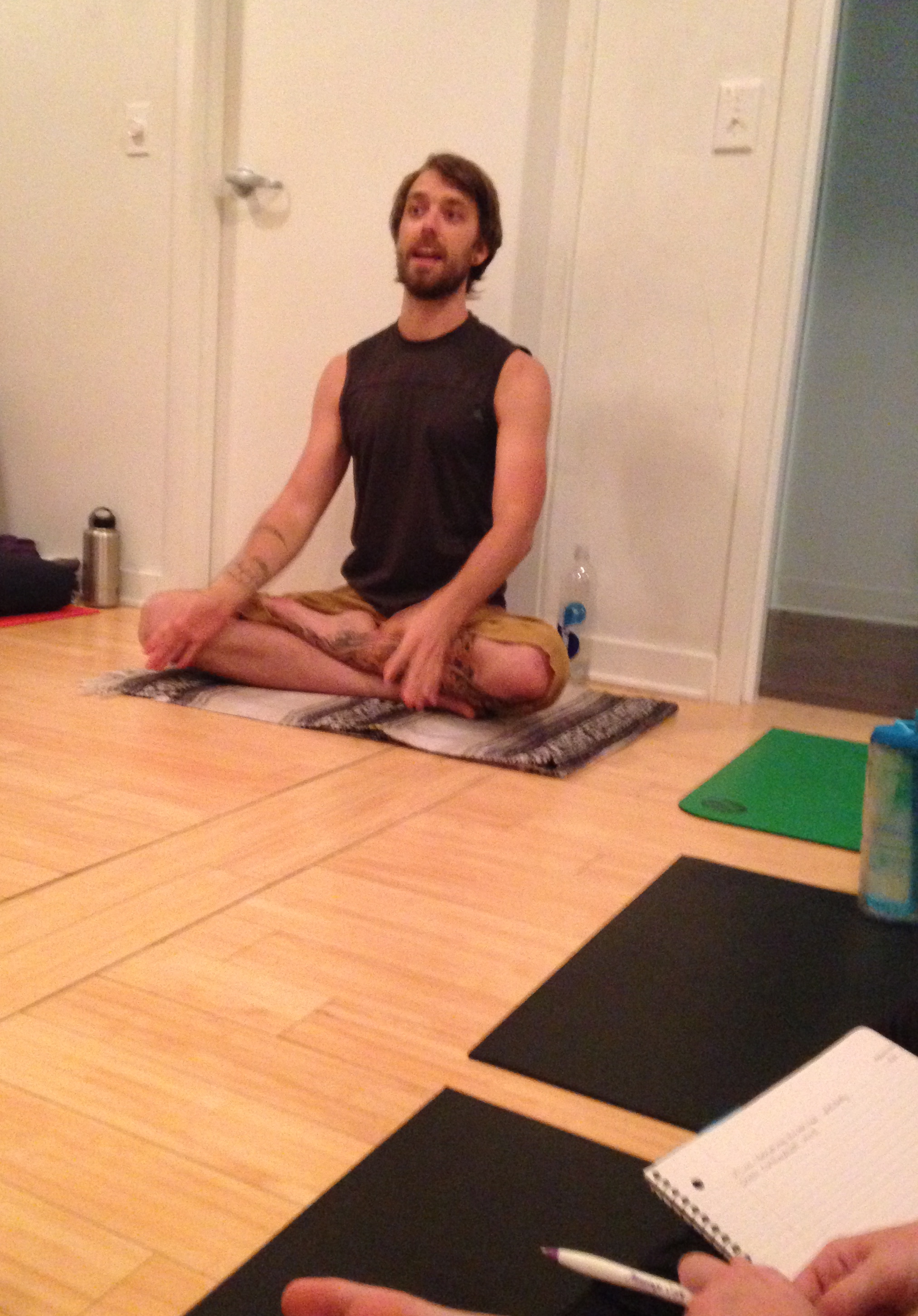
 Last weekend, Lotus House of Yoga hosted Jason Bowman for his third visit to Omaha. Throughout the weekend, he taught classes, workshops, and led an Astanga Mysore practice. Jason is a wonderfully knowledgeable teacher from the Astanga tradition. He is an old soul who sprinkles his teaching with the right amounts of food for thought, fun, and irreverence. I was lucky to attend the Friday night sessions, which had a light and friendly vibe, like a group of friends getting together.
The evening started with a 90 minute Vinyasa practice. The connection to his Astanga roots were clear with his alignment queues and attention to detail. The packed room quickly warmed as the yogis devoured his mindfully sequenced class. Images of an Etch-A-Sketch floated into my mind every time he queued caturanga to “clear the slate” before the next sequence. The pace of the class was mindful with plenty of space to focus on the flow of the breath.
The class peaked at the challenging postures of Tittibhasana 2 and 3. Part of the Astanga Intermediate series, Tittibhasana requires open hips, hamstrings, and shoulders. Activation of all three major bandhas (jalandhara/throat, uddiyana/belly, and mula/root) knits the pose together and facilitates balance. We came into Tittibhasana 2 by standing with legs slightly wider than hip distance, softening the knees, folding forward, tucking the shoulders behind the knees, clasping the hands at the low back, and straightening the legs. Modifications were offered. Once in Tittibhasana 2, we rocked gently from side to side, took a few steps forward and back for the third variation of the pose. It was hard not to smile and giggle at the awkward nature of the pose. I was certainly not alone.
The second half of the evening was discussion and exploration of pranayama. Jason referenced prana as life or the physical body and chitta as the mind or consciousness. He encouraged us to wake up to what is happening between the two. Notice if “prana is pulling on chitta and vice versa”. He noted that when the body is in challenge or distress, it can pull the mind in that direction, dragging it into challenge or distress. For example, if you are stuck in traffic, have to use the restroom, and become very uncomfortable because of it, your mind might begin to swirl and agitate. The prana pulls on the chitta, the body pulls the mind. The opposite can happen as well.
As he spoke, the metaphor of a rope came to mind. Imagine prana and chitta are on opposite ends. Sometimes it’s a tug-of-war, where one or the other is dominating, bullying the other. It’s our task as yogis to get the two to work together, to be cohesive, and to act as one. Instead of pulling the rope, turning the rope rhythmically together. When we eliminate the division and find that balance of the body and mind working together we create harmony and peace. It’s a constant practice.
The remainder of the evening was spent with Jason guiding a seated pranayama practice. Throughout the practice we were encouraged to observe, not judge what was happening as we practice. Jason spoke about the natural fluctuation of emotion that happens with the inhale and exhale during breath practice. Many times, the inhale brings about sensation or feeling of anxiety. I noticed this especially during the four part inhale exercise. At the top of the breath, with lungs to capacity, I did notice tension and tightness bubble up to my neck and face, entering my mind. On the other half of the cycle, the exhale can bring about a sensation of depression. These feelings can be counteracted. The antidote to the anxiety of the inhale can be found in grounding, while the antidote to the depression of the exhale can be found in the lift of the heart.
All in all it was a great way to spend a Friday night. It’s always a treat to be the student and I am blessed to have so many insightful teachers on my path. It certainly makes it a more enjoyable journey.
Enjoy the Journey!


 suzanne wright yoga