1 Comment

#PowerPose 38 – Utthan Pristhāsana

One of my favorite things to witness as a yoga teacher is when students take the practice that you’ve outlined for them and make it their own.  They embody the practice and make it unique.  Sometimes you see this as finding their own pace, altering for their needs, or exploring variations.  Every once in a while you get a glimpse of how students have welcomed the practice into their hearts. They explore the practice physically and emotionally.

This week’s PowerPose, Utthan Pristhāsana or Lizard is one that students like to personalize.  When we find this pose in class you can bet that the variations will number the students in the room.  This pose is very grounding, which might welcome comfort when branching out and experimenting.  It can also be a very intense hip opener, which can force us to modify to the right level. Whatever the case it’s a lovely sight to see each individual yogi finding their unique expression.

Try these variations as you explore and make the practice your own.
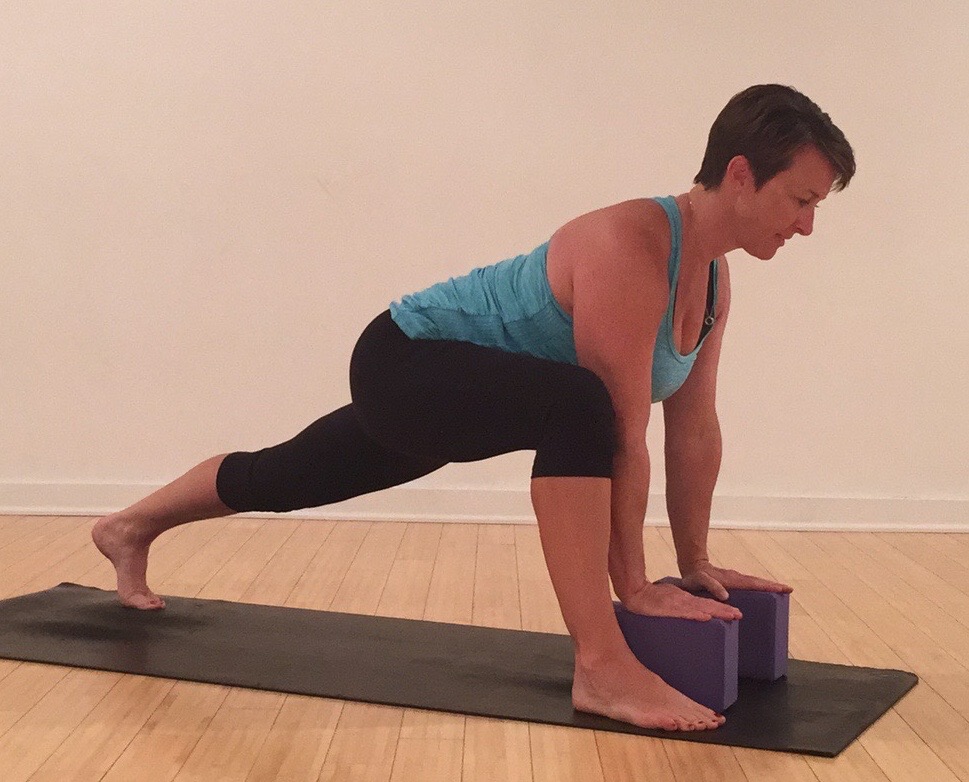
IMG_3697Option 1:  Utthan Pristhāsana with blocks. From down dog, step the foot to the outside of the same hand.  Keep the back heel lifted and the back leg long as if it were in plank.  If there is any tension in the shoulders or neck, take the hands to blocks.  Keep the hands shoulder width, with the arms long.  Find a gentle pull of the hands toward the feet as you reach the shoulder heads wide.  Keep the front foot pointing straight forward with the knee stacked over the ankle, pointing in the direction of the toes.  Gently lift through the pelvic floor as you tone the belly.
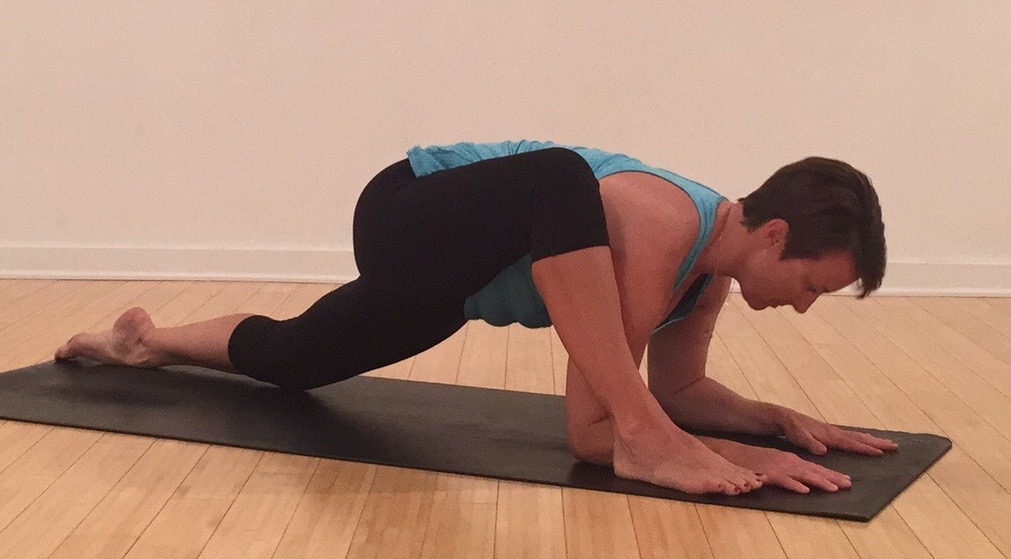
IMG_3699Option 2:  Arms and Back Knee Lowered.  You might think that bringing the back knee down would make this pose easier.  It does change the amount of heat in the pose, but it offers a new level of challenge.  This position of the back leg allows for a deeper stretch through the hip flexor and groin, which can be just as hard, if not more so than option 1.  When range of motion in the shoulders and hips allow, the forearms can be brought to the mat for further grounding and a deeper stretch.  An intermediate step would be to lower the forearms to blocks. Keep the front knee hugging toward the shoulder and keep reaching the heart forward.
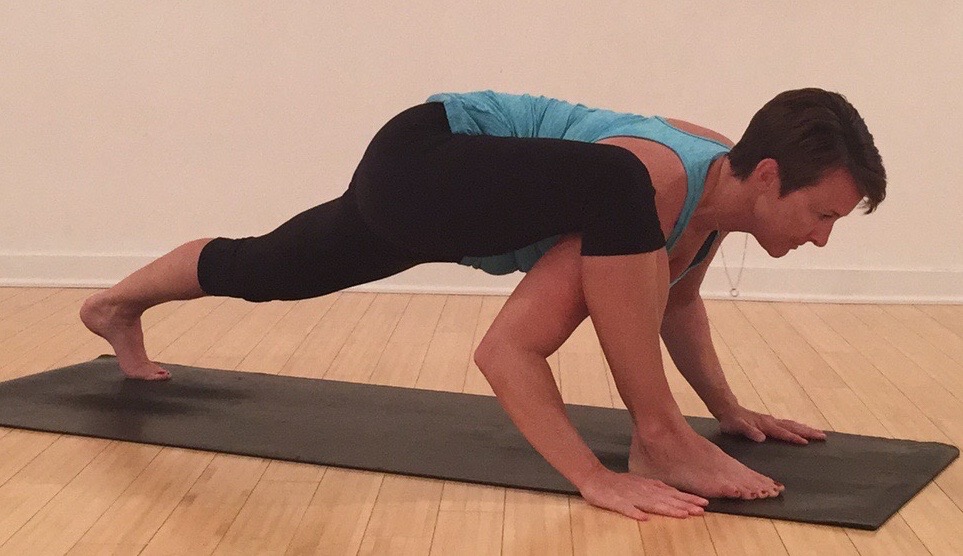
IMG_3704Option 3:  Shoulder Behind Knee.  Smooth the calf muscle of the front leg down with your hand, then start to shimmy the shoulder behind the knee.  This can feel a bit awkward, so be sure to breath as you challenge the opening of the hip.  When you find the right spot, find a gentle pulling back of the front hip.  Keep the shoulders open and broad.  Don’t let the pull back of the hip “bully the shoulder” or make the heart collapse.  Place the hands on the mat or blocks to leverage grounding through the floor.

IMG_3713Option 4:  Bound Utthan Pristhasana.  Plant the back foot as in Warrior I.  Gently scissor the legs,  lift the pelvic floor, and tone the belly.  Reach the arms behind the back to find the bind.  If you are close and need to bridge the gap use a towel or strap.  Open the heart and think of lifting the shoulder that is under the knee.  Find stability and breathe.

Always work where you feel comfortable and find the right amount of challenge for you.  Personalize your practice as you work.  Follow this #PowerPose challenge @suzannewrightyoga on Instagram or at Suzanne Wright Yoga on Facebook.  If you post your pictures or about your experience be sure to tag #PowerPose and @suzannewrightyoga.

1 Comment

#PowerPose 37 – Hanumanāsana

When we think of the heart or the energy of the heart chakra, it’s easy to consider the love of romance.  But, that’s just a small fraction of the capacity of the heart.  The heart chakra symbol is adorned with twelve petals, each representing one of the qualities of the heart.  These qualities are joy, peace, kindness, patience, love, harmony, clarity, compassion, purity, understanding, forgiveness, and bliss.  In these qualities we experience the full capacity of the heart.

This range of qualities is alive in our families.  Whether it’s your family of birth or one that you’ve created, the energy that goes into care and feeding, conflict resolution, and treasuring one another, embodies these qualities of the heart.  Brought together, they create an energy of devotion.

Devotion is illustrated in the heroic tales of Hanuman, the cherished monkey deity of yoga mythology.  Hanuman’s father is Vayu the wind god.  As a god himself, Hanuman’s divinity enables him to do great things.  The feats he performs were motivated not just out of ability or duty, but of a deep devotion, that is rooted in the qualities of the heart.  As the story goes, Hanuman summons his divine essence and leaps over the ocean to help save the wife of Ram his beloved friend and adopted family.  His devotion is so great, legend says that his heart beat the name of his friend, Ram, Ram, Ram.

Hanuman’s pose, Hanumanāsana or Yoga Splits is inspired by his great leap over across the ocean.  As you prepare for and practice this pose, imagine your heart’s devotion so great that it cannot be contained, that your heart could burst from your chest.

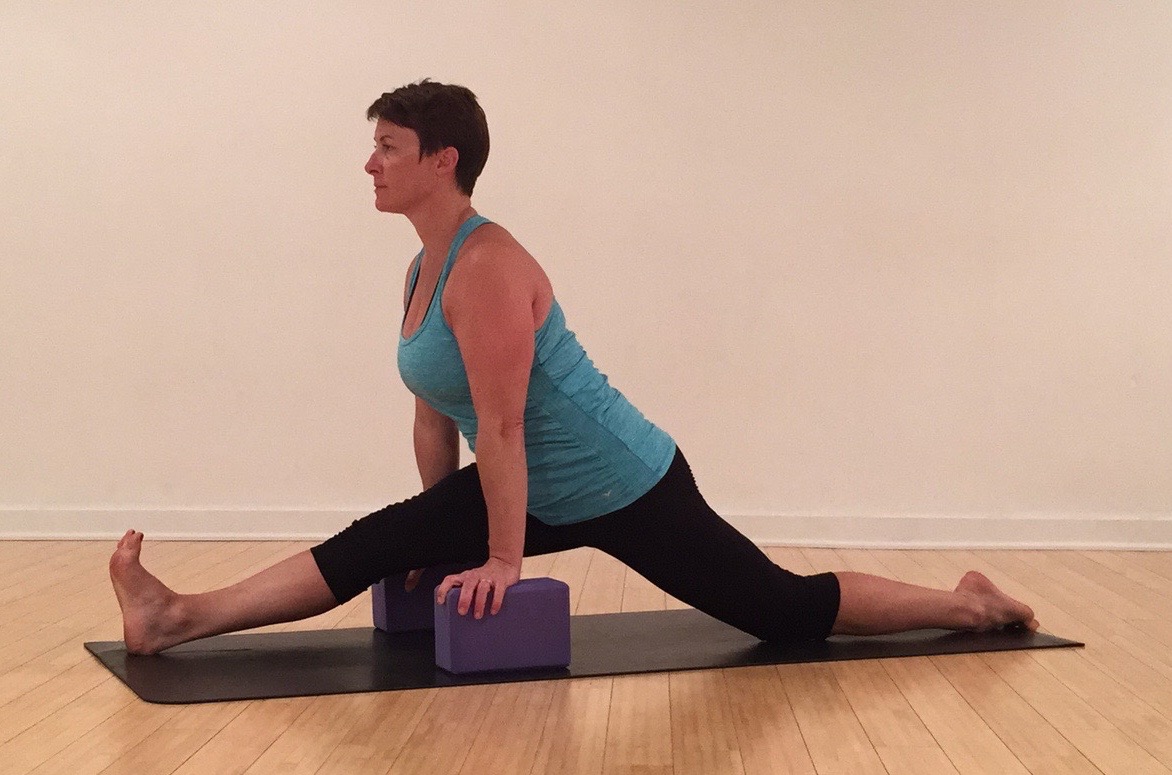
IMG_3519Option 1:  Ardha Hanumanāsana.  From a low lunge, place hands on blocks next to the hips as you slide the hips back.  Stack the hips over the bottom knee.  Press the tailbone back and flex the front foot.  The back foot can be tucked or top of the foot flush to the mat.  Reach the heart open and forward, creating a long back.  Try to create a cobra feeling in the back as the reach of the shoulder heads wide.  Bring the hips in line, by hugging the hip of the front leg back in space.

IMG_3530Option 2:  Increase the Stance.  With hands on blocks or the floor, begin to slide the front heel further away.  As you do, hug the femur of the front leg into the hip socket, as if it’s being suctioned into the body.  Pull the hip of the front leg back to square the hips.  Work to stack the heart over the hips as you move deeper into the pose.  If a full stack is not available, gradually work in that direction.  Begin to lessen your dependency on the blocks or floor with a lift of the pelvic floor and a gentle hug of the inner thighs.  A block or a blanket could also be used under the front leg or root for support.

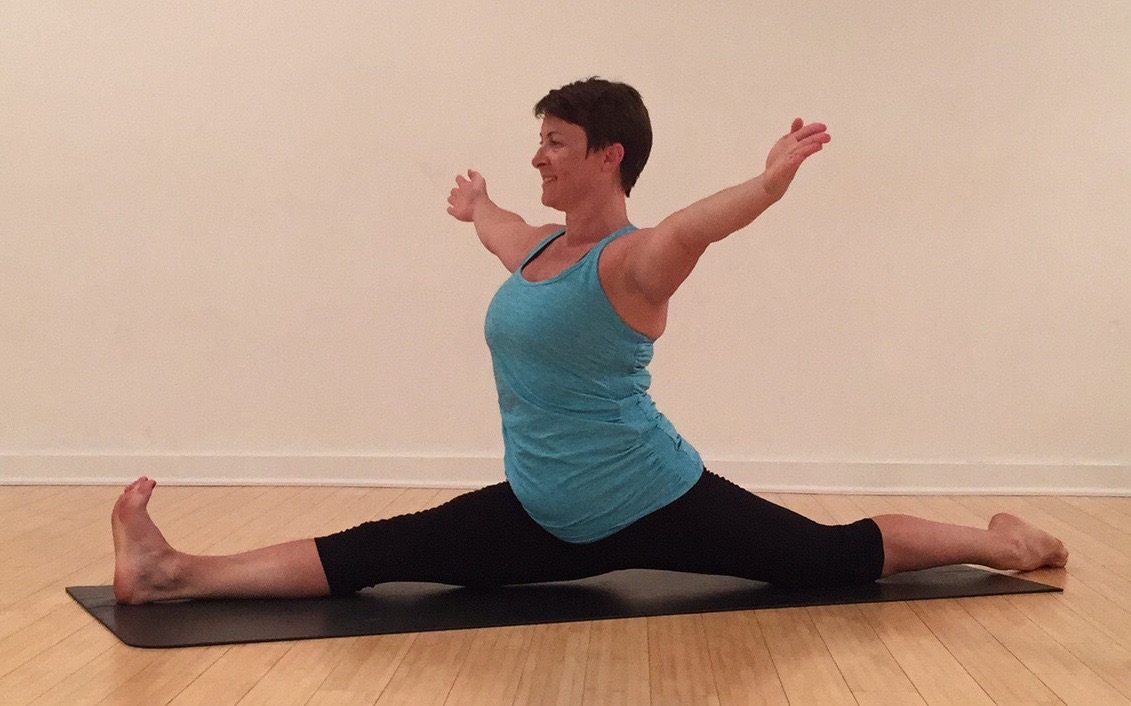
IMG_3551Option 3:  Hanumanāsana.  When you are able, extend the legs completely, resting your root on the floor.  Keep the back hip rolled down, so the knee and shin are facing straight down.  It can be tempting to allow the back leg and knee to roll open. (I’m still working on this!)  Continue to hug the front leg into the hip.  As you find heaviness and release in this position, focus on the gentle toning and lift of the pelvic floor to create balance and buoyancy.  For additional challenge, tuck the back toes, stacking the heel over the toes, and keep the knee and shin facing down towards the mat.  Hands can offer support on the blocks or floor.  For more challenge, reach the arms wide to open the heart further.

IMG_3544Option 4: Bend the Back Knee.  When you can find full hanumanasna, there are lots of other variations to try.  Start with picking up the back foot.  Bend the back knee, keeping the thigh rolled down toward the floor.  Capture the foot with one hand.    Use the lift of the pelvic floor to create balance.  If you feel stable reach back with the second hand.  Another option, if you have the range of motion in the shoulders, is to reach overhead for the back foot.  A strap can be used to bridge the gap between the hands and foot if needed.

You may need to tap into your own divinity to find your peak experience in this pose.  That can take time and focus, but know that it’s all within you.

Always work where you feel comfortable and find the right amount of challenge for you.  Welcome a feeling of devotion and love of your practice as you work.  Follow this #PowerPose challenge @suzannewrightyoga on Instagram or at Suzanne Wright Yoga on Facebook.  If you post your pictures or about your experience be sure to tag #PowerPose and @suzannewrightyoga.
Leave a comment

#PowerPose 36 – Ūrdhva Dhanurāsana Dropback

When we practice the āsana of yoga we get to experience awkward, fun, interesting, and sometimes scary sensations.  We test the limits of our physical and emotional experience.  In this PowerPose, we plunge into the unknown with an open heart.  This can seem big, even daunting, but when we take a step back, when we look at our lives and our practice, we see that we’ve done it before.  Maybe not exactly, but we’ve probably had a similar experience or sensation in the past.  This can make the unknown seem a little less scary, a little more accessible.

Each time we practice and we move outside of our comfort zone, we widen our range of experience.  This can translate to moving out of our comfort zone when we are off of the mat.  Plunging into the unknown might still be scary and challenging, but at least we can be willing to try.  Maybe take a small plunge or two.  If we don’t, who knows what we’ll be missing?

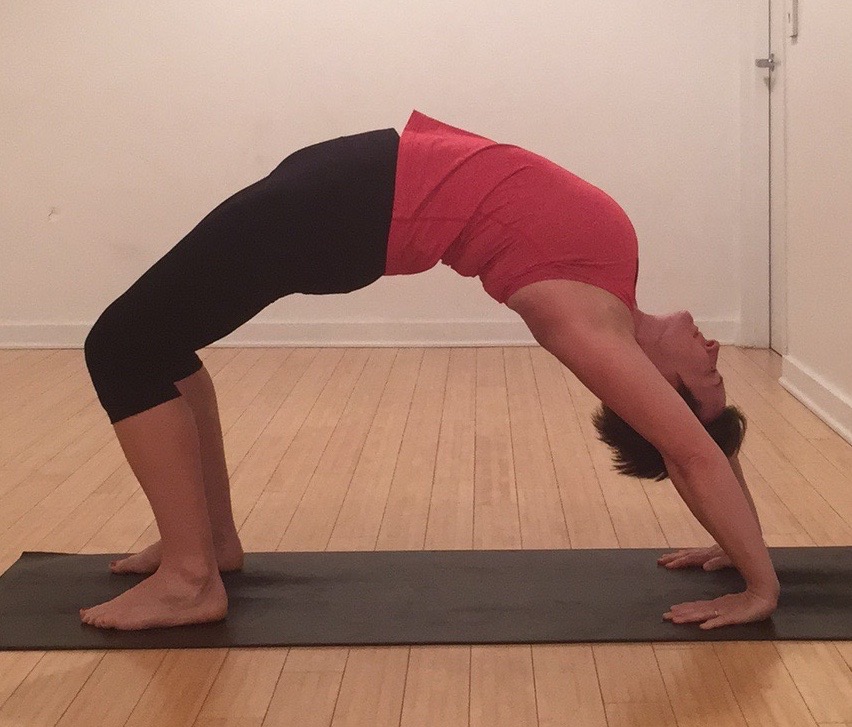
To get ready for the physical plunge of an Ūrdhva Dhanurāsana Dropback, be sure to prime the body for a big back bend.  You can use the three building blocks of this series, Parivṛitta Anjanayāsana, Pīncha Mayūrāsana Prep, and Ūrdhva Dhanurāsana, to prepare.

Try these variations of the plunge:

IMG_3206Option 1:  Standing Ūstrāsana.  Stand with the feet at hip distance and toes forward.  Root through the feet and lift through the pelvic floor.  Place the hands on the back at the hips with the fingers pointing down, coax the tailbone to reach long towards the floor.  Lift the spine like it’s being sucked up through a straw, then lift the heart toward the chin.  Slide the ears back and reach through the crown of the head.  Try to eliminate that “roller coaster” feeling in the neck, face, and jaw, by pressing through the back of the head and softening through the face.  You may need to lift out slightly to find relief.

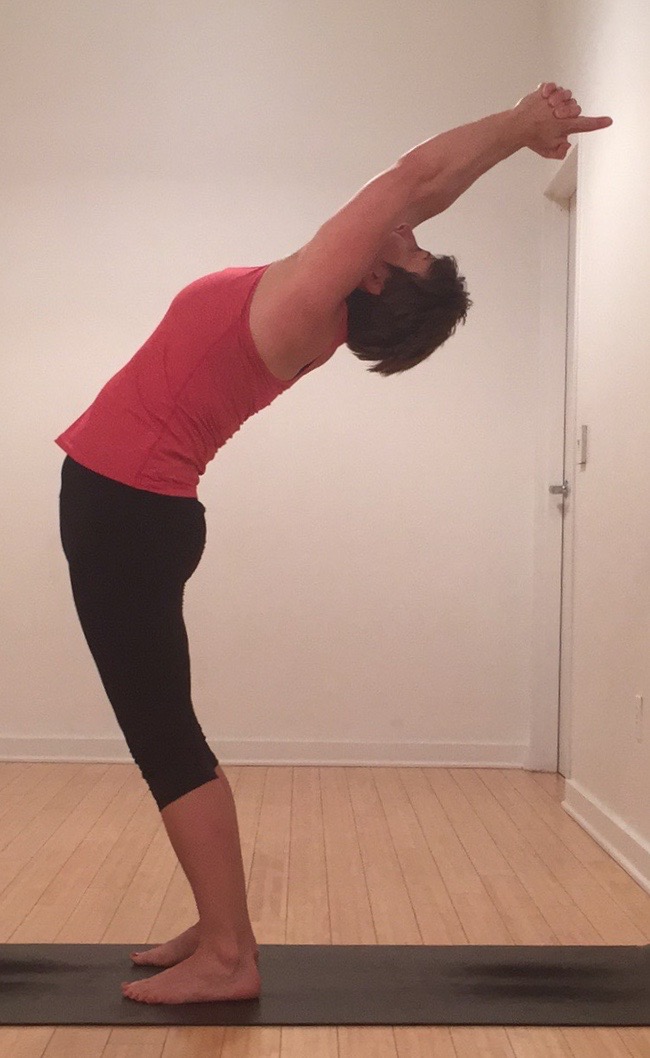
IMG_3208Option 2:  Arms Over Head.  Reach the arms over head, clasp them together, and extend pointer fingers.  Find the same lift as Standing Ūstrāsana.  Use the length of the arms to encourage and extended spine.  Find connection from the rooting of the feet all the way through to the fingers.  As you lift back to standing reestablish the length, the danda of the spine.

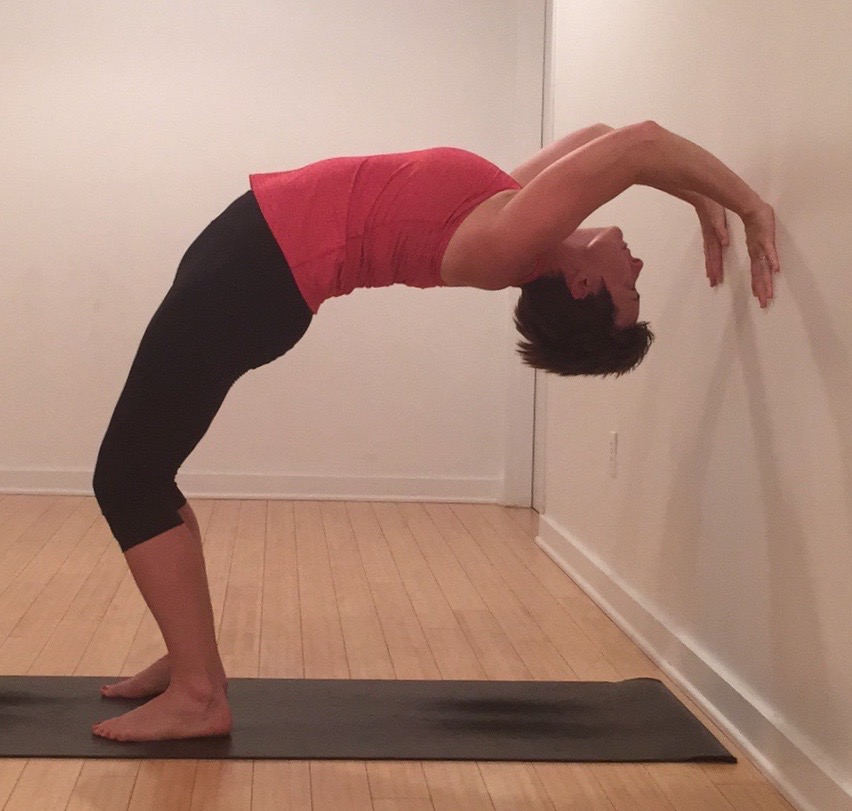
IMG_3210Option 3:  Walk Hands Down the Wall.  Stand about an arm’s length away from the wall.  Approach the wall from option 1, option 2, or with hands at the heart.  Lift the heart and slide the ears back.  When you reach your maximum extension and you can see the wall, reach the hands to the wall.  Pause.  This reach to the wall can feel like a huge leap of faith.  Be sure to breath as you find the wall.  Press the hands into the wall, shrug the shoulders away from the ears, hug the elbows towards the midline and reach the tailbone long.  If you are able, walk the hands further down the wall reaffirming alignment as you increase the back bend.  Take a few breaths when you find your peak.  Slowly, walk the hands back up the wall.

IMG_3202Option 4:  Standing Ūstrāsana Dropback.  Keep working with the support of the wall, gradually moving a little further away and making the initial placement of the hands a little further down.  When you are ready to move from the wall, have an experienced practitioner or instructor assist you.  (They stand facing you in a Warrior I stance with their front foot in between your feet and hands supporting your hips.  They should do no more than slightly slow your movement to the floor.)  With control find extension and the back bend, taking the hands directly to the floor.  Take a few breaths.  To exit lower the hips and shoulders to the floor and pause.

Experience life to its fullest.  Take the plunge into the unknown with an open heart.

Always work where you feel comfortable and find the right amount of challenge for you.  Follow this #PowerPose challenge @suzannewrightyoga on Instagram or at Suzanne Wright Yoga on Facebook.  If you post your pictures or about your experience be sure to tag #PowerPose and @suzannewrightyoga.