1 Comment

#PowerPose 53 – Vṛkṣāsana

On a walk the other day I was taken by the image of a tree that had lost most of its leaves.  They were puddled up around in a circle at the base of the tree.  It was a vibrant pile of bright yellow and earthy brown.  The exposed branches of the tree were expansive and strong.  I could see the abandoned nests tucked in the crooks of the branches, not yet compromised by the wind and other elements. The midday sun was streaming through the naked tree.  The light was penetrating all of the open areas between the branches.

I love this image of light shining through trees. It’s a favorite that I like to capture with the phone on my camera, even though the pictures never do the beauty justice.  In Spring and Summer you have to be there at just the right time, when the sun is rising or setting, for the sun to make an impact on the dense collection of leaves blocking the path of light.  But, in the Fall and Winter the light shines through freely.  Without the clutter and distraction of the leaves, the foundation of the tree is easy to see.

Our minds are like the tree, our thoughts are the leaves.  When we can let them settle and fall away, we are left with a stripped down, exposed, and naked version of ourselves.  In these moments our true Self is easy to see.

Vṛkṣāsana or Tree Pose is our PowerPose of the week and provides an opportunity to focus on balance and hip opening, which we will need for the Peak Pose of this series.  It might not seem like much of a challenge, it ranks as one of the easiest postures on Iyengar’s scale.  It is, however, a good reminder that  the challenge of yoga does not come from the degree of difficulty in the poses, but in the challenge to calm our minds and invite our true spirit to shine.

Try these stages and variations.
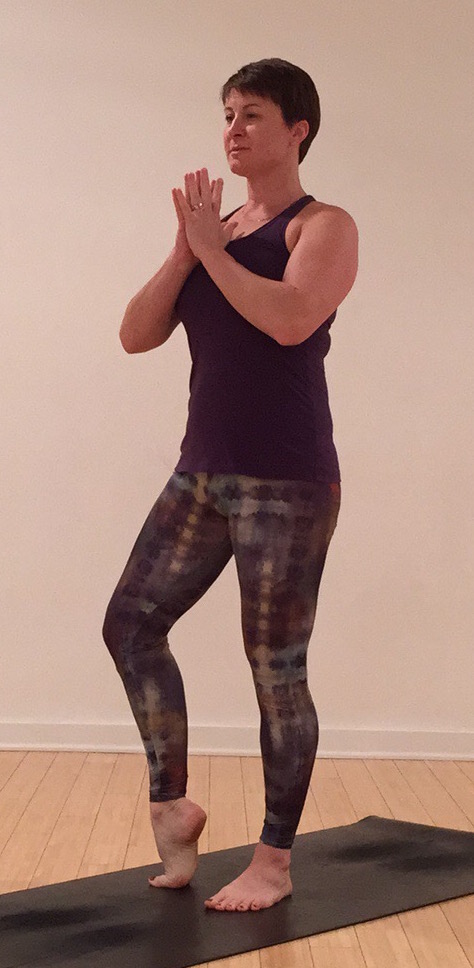
IMG_5300Option 1:  Kickstand with Hands in Prayer.  Standing Tall in Tadasana or Mountain Pose with a long spine, reaching through the crown of the head.  Find a drishti, or a gaze at a spot or object that is not moving.  Bring attention to the feet.  For balancing leg, press into all four corners of the foot, lift through the arch of the foot as if you were suctioning the foot to the floor.  Turn the opposite knee out, taking the ball of the foot to the mat.  Lift through the heel, press down through the ball of the foot, and press the knee open.  Take the arms into prayer in front of the heart, keeping the collarbones broad.  Tone the belly and the ribs to the spine.  Find balance for 5-10 breaths, then repeat on the opposite side.
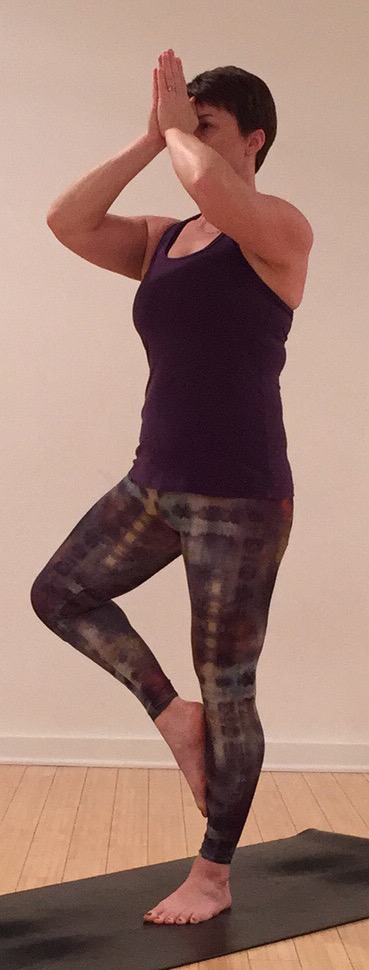
IMG_5302Option 2:  Foot to Calf with Hands to Third Eye.  Place the foot on the calf.  The arch of the foot, fits nicely along the contour of the leg.  Keep the standing leg active as you gently press it and the foot together.  Raise the hands to the third eye, gently press the thumbs to the forehead.  This will obstruct your drishti, causing you to employ peripheral vision and making balance more challenging.
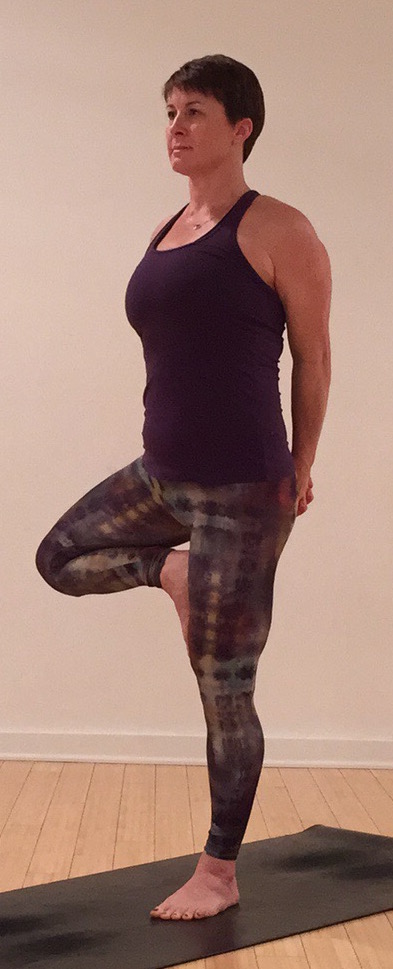
IMG_5308Option 3:  Foot to Inner Thigh with Hands Clasped.  Draw the foot higher up the leg.  Be sure the place the foot above the knee.  Hug the leg and foot together, creating a little heat and gentle tension through the inner thigh and groin.  As the foot moves up the leg, the hip can hitch up, gently draw the hip of the bent knee down working to level the hips.  Check your pant band in the mirror and try to draw it parallel to the floor.  Keeping the spine long and the belly toned, reach the hands behind.  Hold the forearms or clasp the hands.  Keeping the back open, pull the shoulder blades down the back.  Avoid squeezing them together.  Opening through the shoulders can cause the belly and ribs to disengage, so check in to make sure they are still integrated.
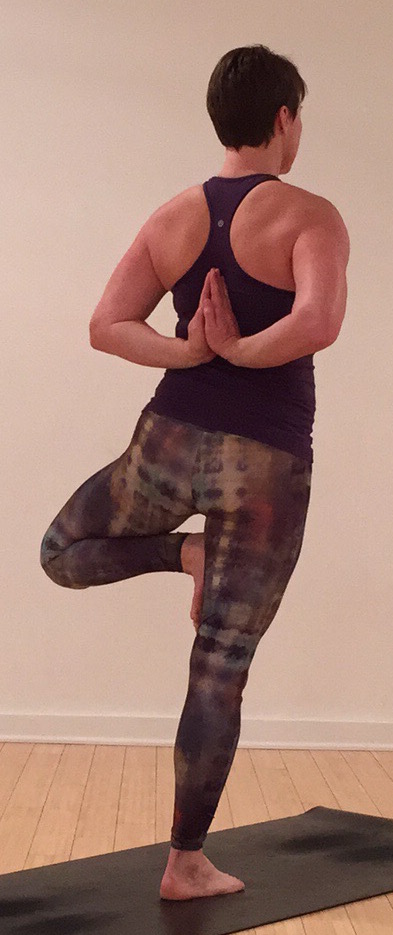
IMG_5315Option 4: Vṛkṣāsana with Reverse Añjali Mudrā.  For more challenge with the opening of the shoulders, place the hand in Reverse Añjali Mudrā.  Turn the palms up, bringing the pinkie edge of the hand to the back.  At first there may be be a gap between the palms, with just the fingertips making contact.  As much as the shoulders allow, press the heels of the hands together.  As mobility increases, the hands will come together as if they were in front of the heart.  For more challenge, lift the hands higher up the back.  Check in with the stability of the pose, levelness of the hips,  and the integration of the belly and ribs as you proceed.

As you work on Vṛkṣāsana, find your balance while challenging the openness of the hips and shoulders.  More importantly, settle mind, clearing the way for your true Self to be exposed and brought to light.  Follow this #PowerPose challenge @suzannewrightyoga on Instagram or at Suzanne Wright Yoga on Facebook.  If you post your pictures or about your experience be sure to tag #PowerPose and @suzannewrightyoga.

Leave a comment

#PowerPose 52 – Dwi Pāda Viparīta Daṇḍāsana

Happy November Yogis!  This month of gratitude offers so much to celebrate.  The weeks leading up to Thanksgiving are filled with almost constant reminders to be thankful and open-hearted.  Like our yoga practice, gratitude has a balance all it’s own.  Sometimes it flows fully and freely, other times, it builds starting slowly and gradually gaining strength.  Understanding these personal nuances becomes more apparent with regular practice.  Frequent tending and exploration yields rich and insightful results on the mat or in your heart.

I couldn’t think of a better way to cap this four pose series and celebrate over a year of posts, than with a big heart opener.  This posture is a big back bend like Ūrdhva Dhanurāsana or Upward Bow, but it requires even more participation from the shoulders.  It’s also necessary to be mindful of the neck as you are placing the crown of the head to the earth.  The preparatory work that we’ve done with Śīrṣāsana, Aṅjaneyāsana, and Supta Vīrāsana will get you ready to explore this pose.

There are several ways to get into this pose.  A more traditional approach would be to come to Upward Bow and then come to the elbows.  However, since I am less mobile in the shoulders this entry has always been more challenging for me.  I found that if I enter via Śīrṣāsana and use the wall, I can slowly coax my shoulders to open and be prepared for the back bend.  The Śīrṣāsana entry also provides that exhilarating moment where you have to take a leap (okay a reach) of faith before your foot finds the wall or the earth.

Try these variations:

IMG_4930Option 1 – Śīrṣāsana with Hanuman Legs at the Wall.  Place your mat with the short side against the wall.  Position your headstand, so that you are at least one foot away from the wall.  (As you move into this pose, be very aware and cautious of the neck.  If at any time, you feel the neck is compromised or your forearms and shoulders are not providing enough support come out with control right away.)  Come into headstand and pause, us the structure of the arms and shoulders so the crown of the head is bearing little or no weight.  Separate the legs and reach one foot towards the wall without disrupting the stability of upper body.  With a foot on the wall, reaffirm the pressure of the forearms and lengthen through the spine.  Take a few breaths and then switch legs.  As you become more confident and stable, move further away from the wall until you reach the distance of about 3 feet or more away.

IMG_4932Option 2 – Two Feet on the Wall.  Try this next stage when you feel stable and confident in Option 1.  Slowly, take the second foot to the wall.  Press into the balls of the feet and spin the inner thighs towards the floor.  Hollow out the armpits and reach the front of the heart away from the wall.  While pressing the forearms into the mat, lengthen through the spine, reaching the tailbone to lengthen out of the low back.  Take a 5-10 full breaths, then slowly exit the pose by reaching one foot away from the wall and towards the floor.  If you feel any discomfort in the neck, shoulders, or back, slowly back out to lessen the back bend or come out of the pose all together.

IMG_4933Option 3 – Walk Down the Wall.  First, ensure that you are far enough away from the wall.  When you are further away, the initial reach of the foot toward the wall may feel like a leap of faith.  But, as you walk the feet further down the wall, you will be thankful for the extra space that allows for a longer back bend.  Slowly, walk the feet further down the wall.  Each time you go deeper, pause, reaffirm the shoulders, length of the back and press of the feet into the wall.  If you feel you have more space or are ready for more challenge, then walk the feet further.  Keep working this walk down the wall until you can comfortably walk the feet all the way to the floor.  As the back bend increases the elbows may want to lift from their grounded position.  If this happens, more shoulder opening is needed.  Take time to work in a less intense back bend and other shoulder openers before you proceed.

IMG_4918Option 4 –  Dwi Pāda Viparīta Daṇḍāsana.  As you practice at the wall, gradually move your starting point further and further back.  Over time you will become more controlled and at ease with the reach of faith to get the foot to the wall.  When you’ve developed the shoulder and back mobility to comfortably walk your feet all the way to the floor you may be ready to try the transition without the wall.  It’s helpful to have an experienced instructor assist you the first time you transition from Śīrṣāsana to Dwi Pāda Viparīta Daṇḍāsana.  Spotting the transition can help you to remain calm and in control of the transition.  When you build up the confidence, make the transition on your own, moving slowly and mindfully.  When the feet find the floor, press firmly into all four corners of the feet, paying special attention to the big toe ball mounds.  Roll the inner thighs toward the midline and towards the ground.  Hollow out the armpits and press the heart through the opening of the arms.  To exit, release to your back and pause.

Whether you are ready to bust your heart open or if you need to ease into it, work where you can find the right balance of work and ease, making sure to keep the body safe.  Follow this #PowerPose challenge @suzannewrightyoga on Instagram or at Suzanne Wright Yoga on Facebook.  If you post your pictures or about your experience be sure to tag #PowerPose and @suzannewrightyoga.

1 Comment

#PowerPose 51 – Supta Vīrāsana

This pose was my kryptonite.  There was a time, that if I heard a teacher queue this pose, my whole body would cringe.  I just didn’t like it.  It was a pose that didn’t fit naturally, I couldn’t muscle it (and shouldn’t muscle others either), and progress was extremely slow.  I’ve never had major knee injuries, so that wasn’t the problem.  My knees were tight, and combined with my fleshy legs, it seemed impossible to find ease.

I built a mental wall around this pose.  Before working with it or even trying to find the posture, negative conclusions had already been made in my head.  It became a self-fulfilling prophecy.  Working through these types of challenges is where I find the true spirit of yoga.  This is when the practice transforms from shapes on a mat to Yoga.

Vīrāsana or Hero’s Pose is a big knee, hip, and quad opener.  The reclined variation is a back bend and opens the front gates of the body including the psoas and hip flexors.  If your knees are compromised due to injury, you may want to be generous with props or avoid this pose all together.

Try these variations:

IMG_4868Option 1 – Kneeling.  A thin blanket under the knees can be used to cushion sensitive knees.  From Down Dog or All Fours, space the feet and knees hip distance and come to high kneeling.  With the tops of the feet flush to the mat, sit the hips down on the heels.  With a long spine, reach the tailbone toward the heels without tucking.  Rest the hands on the thighs and soften the shoulders.  If this is too much compression on the knees or too intense through the quads, prop the hips with a block or blanket.  If you notice numbing in the feet or you loss of blood flow, prop the hips up higher to avoid such deep compression.  Stay for 5-10 breaths if possible.  When you come out, find Half Plank or Down to counter balance this pose.

IMG_4873Option 2 – Vīrāsana.  Return to high kneeling with the feet and knees hip distance.  Adjust the knees slightly narrower and the heels slightly wider to make space for the hips.  Sit the hips back towards the floor.  The feet should align just to the outside of the hips with the knees pointing directly forward in line with the hips.  If needed prop the hips on a block or blanket and find the right amount of knee compression and quad opening.  To maximize the rotation of the knee, press the blade or pinkie edge of the foot towards the floor.  If needed, you can gently press the thumbs into the pinkie toes or heels of the hands onto the blade edge of the feet to coax the opening.  As you breathe, find a gently drawing in of the belly and ribs.

IMG_4878Option 3 – Supported Supta Vīrāsana.  When your hips can come completely to the floor without support you are ready to move further.  (I had to stay at option 2 for a long time!)  Gently tone the belly and ribs toward the spine and begin to lean back.  Keep the spine long and the neck in line with the spine as you recline.  Come first to the hands, reaffirm the length of the spine, the reach of the tailbone, and the heaviness of the knees.  If the pose has degraded at all, then scale back.  If the integrity of the pose remains, and you feel you can go further, bring the elbows to the floor.  The head can stay in line with the spine or it can be released back to expose the throat.  Avoid hunching through the shoulders and dumping into the traps.  As you slowly exit the pose, return first to the kneeling posture, pause for a few breaths, then proceed to exit.

IMG_4889Option 4 – Supta Vīrāsana.  To go further in the pose, release the back all the way to the floor.  Hands can be along the body, out to the side or overhead.  The knees stay heavy to the floor.  If they begin to lift away, it’s a sign you’ve gone too far.  Keep the gentle toning of the belly and ribs and reach the tailbone toward the knees.  Keep a small, natural curve in the low back.  If you notice a bigger gap, back out or support with a blanket.  Soften and surrender towards the floor.  When you are ready to exit, press into the elbows and come up slowly.

What poses do you build walls around?  Better yet, have you predetermind outcomes for life experiences?  Give yourself the benefit of an open mind and some space for these experiences to unfold as they will in their own time.  In some cases this may require a heroic effort of patience.

As always, work where you can find the right balance of work and ease, making sure to keep the body safe.  Follow this #PowerPose challenge @suzannewrightyoga on Instagram or at Suzanne Wright Yoga on Facebook.  If you post your pictures or about your experience be sure to tag #PowerPose and @suzannewrightyoga.