Leave a comment

The Heart of Yoga

heart of yogaThe Heart of Yoga T.K.V. Desikachar, along with Light on Yoga by B.K.S. Iyengar, are my two favorite references for yoga. When I am planning classes or contemplating teachings it always seems to provide guidance and clarity.

The first time I read this book, I remember thinking, “Yes! This is what I was trying to get my students to understand!” Many times it was like reading what I knew in my heart, but could not put into words. The Heart of Yoga makes the complex teaching of yoga accessible, ties everything back to the ancient teachings and always gives you something more to consider.

Reading and researching yoga can make your head spin. With 5,000 years of study it can be difficult to scratch the surface. Desikachar makes the very complex teachings of yoga accessible. For example, right at the start of the book, he provides the following gem.

“Books or yoga classes often give the impression that there are prerequisites for the study of yoga…We begin where we are and how we are, and whatever happens, happens.” (p. 7)

As students and teachers it’s okay if we don’t know everything and in fact maybe it’s better. That way our experience is not muddled and we can allow it to unfold. If we are present for the teachings we will learn what it is we need to know.

Desikachar is authentic. The experience he shares from his teachers, integrating sanskrit, and presenting the sutras (in discussion and as a text) creates credibility. I love the dissection of sanskrit and understanding that comes with it. The photos of his teacher – Krishnamacharya, students, and family give you an peek in to his life and journey which also adds to the credibility of his word.

The book is eloquent. On a personal note, I have a difficult time writing in or highlighting books. But, his writing really speaks to, many times as poetry. My copy is riddled with highlighted passages. Combining accessibility and eloquences make the experience as the reader more complete.

“The quality of the breath is therefore the clearest indication of the quality of our asana practice.” (p.23)

Whenever I come back to this book, it usually starts because I am working through a concept or challenge. I’m left with a better understanding, but always something more to think about. There are some sections I’ve read and re-read a number of times and each time I learn something new. This makes the book a wonderful resource when planning classes.

This book is a cherished part of my library. I regularly revisit it. My favorite books are the ones that I read and re-read. The Heart of Yoga definitely qualifies.

Leave a comment

Failure is Opportunity

“Failure is the opportunity to begin again, this time more intelligently.”

-Henry Ford
Failure Ford

1 Comment

#PowerPose 50 – Aṅjaneyāsana Variation

The pose Aṅjaneyāsana or Crescent Lunge is named after Aṅjanā, Hanumān’s mother.  Hanumān, the monkey king, has a legendary capability for love and devotion, which is illustrated in the epic of Rāmāyaṇa.  It’s easy to see that this pose is related to Hanumānāsana, especially because of the open heart.

It’s always lovely to meet the children of my yoga students either at Family Yoga or just out and about in the community.  It’s easy to see reflections of their parents (and grandparents) in their smiles, mannerism, and how they interact with others.   The phrase is true, “the apple doesn’t fall far from the tree.”

The pose dedicated to Aṅjanā cultivates open hip flexors, hamstrings, quads, and balance.  In this assymetrical pose, it’s the drawing back towards center or being rooted at home that provides the stability to experiment with variations.  As you progress through the variations of Aṅjaneyāsana stay grounded with a gentle hug of the inner thighs and a lifting through the pelvic floor.  (Isn’t that just perfect for a pose dedicated to a mother?)

Try these variations:

IMG_4895Option 1 – Hamstring Mobility.  This first stage might require a little pep talk, especially if your hamstring is quick to seize up when asked to engage.  Find a kneeling lunge with the foot and knee about hip distance apart.  The front need should be stacked over the front ankle, with the ankle and knee pointing forward.   If the back knee is sensitive, place a thin blanket under it or double up the mat to provide cushion.  With hands on blocks or on the thigh, slowly, bend and straighten the back leg, drawing the heel towards the glute.  Try to keep the movement of the leg in line with the hip, or moving directly up and down.

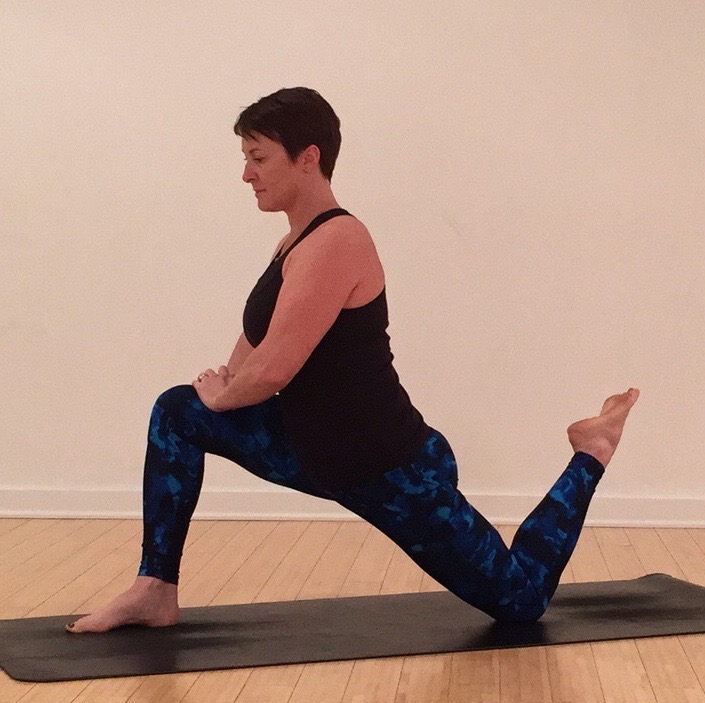
IMG_4898Option 2 – Quad Stretch.  From the kneeling lunge, bend the back knee.  Reach back with the same hand and grab the foot.  Draw the foot towards the glute as much as the knee and quad allow.  Keep the ankle long and active, avoiding a curving or collapsing through the ankle.  If the torso twisted open as you grabbed the foot, square the heart towards the front knee, keeping the collarbone and shoulder heads broad.  This creates an added bonus, a shoulder stretch.  Breathe for 5-10 counts.  When you release the foot, try to control the decent of the foot and come out of the pose slowly.

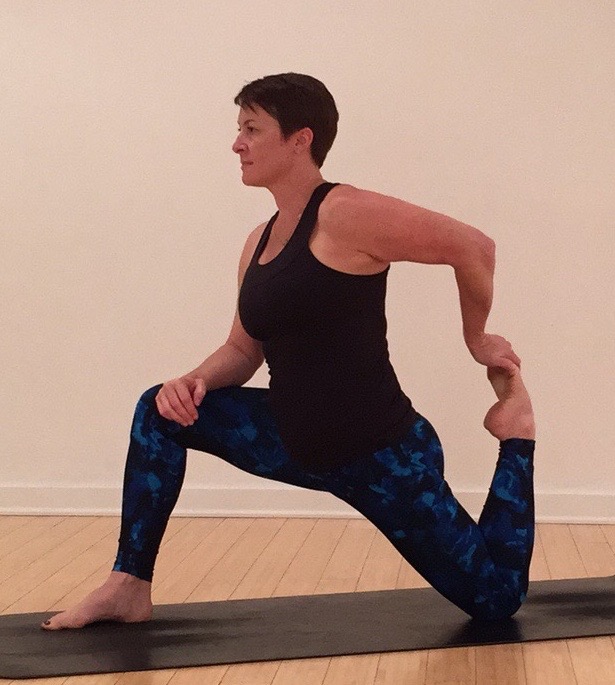
IMG_4900Option 3 – Aṅjaneyāsana Variation.  From the kneeling lunge, bend the back knee.  Reach back with the same hand and grab the foot.  The hand can be positioned to grab the blade edge (as shown) or arch edge of the foot.  The different positions allow different angles for opening the shoulder, so try both.  Reach the tailbone toward the ground and lift the heart.  Kick the foot into the hand and resist the kick with gentle resistance of the hand.  Sink a little further into the lunge.  The free hand can rest on the thigh or heart.  You can also reach it overhead.

IMG_4909 (1)Option 4 – With a Strap.  For a deeper back bend, begin to reach overhead for the foot.  This will be inaccessible for most yogis (including me), so use the strap to bridge the gap.  In this case of using the strap, the idea is to maintain the integrity and intention of the posture, so that over time we may eliminate the need for the prop.  The positioning of the body will look the same with or without the prop.  Place a small loop around the back foot, making sure the buckle or hardware is not pressing into the foot.  Holding the strap, reach the arms overhead and begin to walk the hands towards the foot.  The elbows will be pointing up with the hands as far reaching as is possible.  Hug the elbows gently towards the midline of the body, soften the shoulders down the back, hollow out the armpits.  When you are in position, kick the foot away maintaining gentle pressure with the strap.  Keep the back ankle long the foot active.

As you practice this posture, think about those people in your lives who have shown you care and devotion.  How can you take what you’ve learned from them and pass it on to someone else?

Be sure to start with a little love of yourself, moving gently and mindfully as you practice.  Follow this #PowerPose challenge @suzannewrightyoga on Instagram or at Suzanne Wright Yoga on Facebook.  If you post your pictures or about your experience be sure to tag #PowerPose and @suzannewrightyoga.