“To me every hour of the day and night is an unspeakably perfect miracle.”
-Walter Chrysler
“To me every hour of the day and night is an unspeakably perfect miracle.”
-Walter Chrysler
Many of the pose names we learn are easy to remember as they are names of animals, object, or actions. But, there are many poses that are named after sages, as this one is. This week’s PowerPose is dedicated to the sage Kouṇḍinya.
Kouṇḍinya was a wise teacher, who served in the court of King Suddhodana. When Prince Siddhartha, the king’s son, was born, Kouṇḍinya bravely predicted that the prince would renounce the thrown, leave the kingdom, and discover the path to happiness and truth. As you can imagine, this news was not welcome to the king and Kouṇḍinya was banished.
The prince was raised in a very sheltered environment. He was only allowed to see youth, health, and abundance. When he was older, the prince was finally allowed to venture into the city. Here he was able to see a clearer picture of the world which included age, sickness, poverty, and death. After this eye-opening experience, the prince fulfilled the first part of Kouṇḍinya’s prediction. Prince Siddhartha renounced the thrown and left his father’s kingdom. He dedicated his life to finding an end to suffering. He began to learn from Kouṇḍinya, who taught the prince the practice of asceticism. This extreme self-discipline is a lifestyle that refrains from worldly pleasures as a way to attain peace and end suffering.
Unfortunately, this path did not lead Prince Siddhartha to enlightenment. He was skeptical of this path and they parted ways. Prince Siddhartha discovered the path to happiness and truth as the Middle Way, the path of Buddhism. The teacher, Kouṇḍinya, realized that Siddhartha had become the enlightened one and reversed roles to become the student.
There are a lot of lessons to glean from the story of Siddhartha and Kouṇḍinya. One is that a gentle dose of skepticism encourages you to digest what you’ve been taught then to think and do for yourself. Another is the evolving relationship of teacher and student. It’s important to be open to BOTH roles. If we are always taking one seat or the other, we are missing out on opportunities to share what we know or to gain a new perspective. Each one of us should experience both roles.
The complexities of these lessons are embodied in this pose. Eka Pāda Kouṇḍinyāsana #2 or the second variation of the pose dedicated to the sage Kouṇḍinya requires the hamstring opening of Hanumanāsana, the hip opening of Utthan Pristhāsana, and the asymmetrical balancing of Eka Pāda Bakāsana. It also requires finding a precarious balance that is unique to each yogi. Try these variations as you explore.
 Option 1 – Utthan Pristhāsana. From Down Dog with the feet just wider than hip distance, and the hands at shoulder width, step one foot forward to the outside of the hand into Utthan Pristhāsana or lizard. Come down to forearms to experience as deep opening through the hips. Coil the belly activating Uḍḍiyāna Bandha and reach the heart forward.
 Option 2 – Bear Weight on Hands. From Option 1, come to the hands and walk the front foot back a few inches. Begin to shift forward, bending the elbows into a caturanga shape as you rest the front inner thigh on the tricep. The opposite elbow can pin to the hip of the back leg to create structure as you prepare for the balance. Keep the back toes on the ground with the back leg active and long. Continue to activate Uḍḍiyāna Bandha.
 Option 3 – Finding Balance. Continue to reach the heart forward until you can gently tap the back toes away from the floor. Always come into balance without hopping or jostling to promote happy shoulders and wrists. Keep the front leg bent until you can find balance. The hip of the back leg can stay pinned to the elbow, or the stance of the hands can widen and you can try to float the hip. The back leg reaches with intention and the heart matches the reach to help create balance.
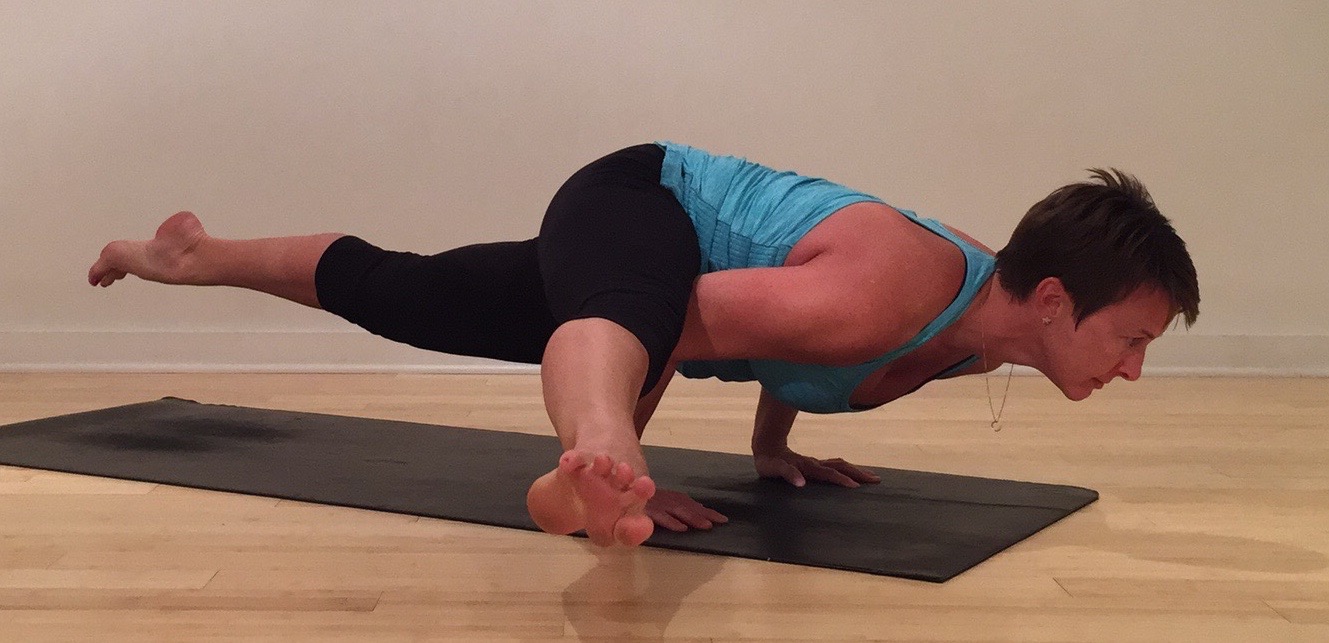 Option 4 – Full Expansion. When you feel stable in the balance, begin to slowly reach the front foot forward, as much as the hamstring allows. Keep all of the activity in the reach of the back leg, lift of the belly, and reach of the heart as you change the shape of the pose. As range of motion and flexibility increases, move the front inner thigh higher up the tricep. Some yogis will be able to get the front thigh as high as the shoulder then extend the leg in a more forward direction.
A big part of yoga practice is finding the path that is just right for you. Remember this as you you are work and find the right amount of challenge for you. Follow this #PowerPose challenge @suzannewrightyoga on Instagram or at Suzanne Wright Yoga on Facebook. If you post your pictures or about your experience be sure to tag #PowerPose and @suzannewrightyoga.
A fundamental action in many arm balances is the employment of Uḍḍiyāna Bandha. This energetic element starts as a muscular upward lift of the low belly. It develops into the harnessing of Prāṇa or lifeforce in the body to create a flying up effect. This is how a physical pose can transform from just an arm balance to flight.
Eka Pāda Bakāsana or One-Legged Crow is one of the first poses where yogis can really explore and appreciate uḍḍiyāna bandha. If you are strong enough in the upper body and have a solid base with the hands and arms, you can find Bakāsana or the two-legged version of the pose without any help from the bandha. You can “muscle” yourself into the posture. But, if you take one of the of the legs away it can be very difficult to stay up without it. In order to reintroduce ease and balance to the pose, you must leverage the lifting of energy from the belly up toward the head.
It’s helpful, almost a requirement, that Bakāsana is in your practice before moving on to this one-legged variation. Create a strong foundation in crow before trying these variations.
 Option 1 – Slide One Knee. From Bakasana or Crow Pose with uḍḍiyāna bandha activated. Keep reaching the heart forward, and gently slide one knee off the tricep, trying to maintain balance. Be sure to hug the stationary knee toward the mid line of the body as you change position. Move slowly, making small adjustments. If you are able, replace the knee, pause, then slide the other knee off the tricep. Notice if one side was more accessible than the other.
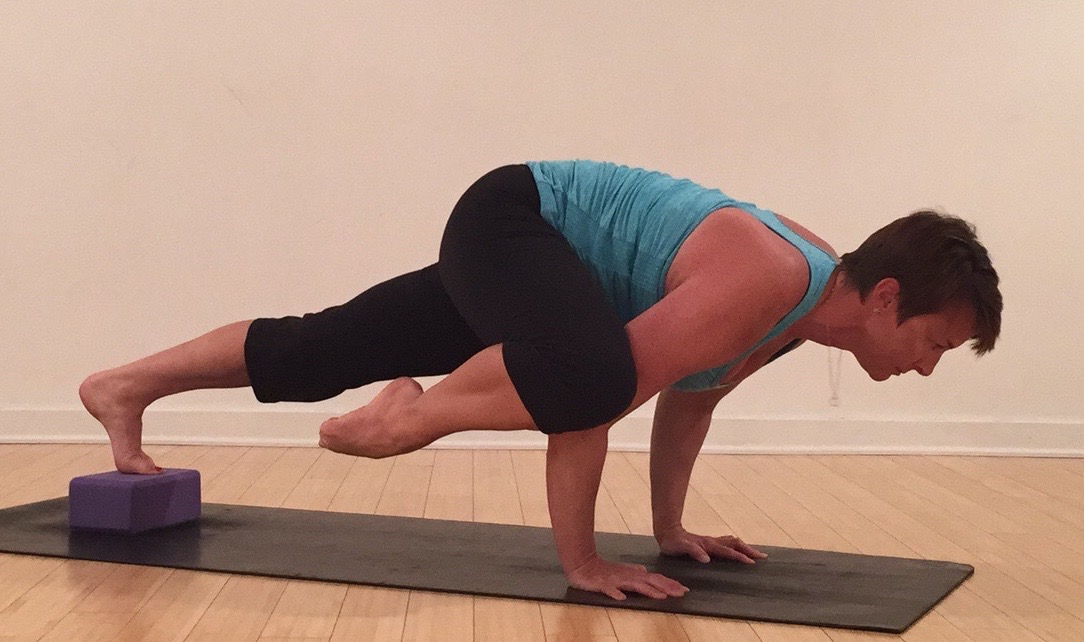 Option 2 – Back Foot Propped or Parallel. From Downward Facing Dog, bring you knee to the tricep as you shift forward, bending the elbows to a Caturanga or push-up shape. Reach your heart about a foot or two in front of your fingertips. Gently teeter further forward as you prop the back foot up on a block or bolster. This support through the back leg will help you find the balance point or fulcrum. Since the back leg is long, the heart has to reach even further than it would in Bakāsana. When you are able, float or lift the back leg without the use of a prop, keeping the leg parallel to the floor.
 Option 3 – Back Leg Ascending. This variation is especially helpful for yogis who are working towards the press to handstand (a blog for another day). Leveraging the lift of uḍḍiyāna bandha, shift the heart a little further forward as the back leg lifts skyward. As you move, focus on the shape of the arms, keeping both arms hugging to the midline. It can be tempting to allow the free arm to wing out, but keep the structure to maintain a solid base. As your upper body bears more weight, it can cause a sinking through the heart. Using uḍḍiyāna bandha will help you maintain the lift away from the floor.
 Option 4 – From Śīrṣāsana. If you have a stable tripod headstand practice, try the traditional entry to this pose. From headstand, slowly hug one knee to the chest and set it on the tricep. Press down with the shin, lift through the belly, and reach the heart forward to lift into Eka Pāda Bakāsana. Work to come into the pose without touching down the back foot. In order to do this you’ll need to engage (you guessed it) uḍḍiyāna bandha. Move slowly as you harness the body’s strength and energy to find the arm balance.
Going from Bakāsana to the One-Legged Variation can be like the work of a building inspector. As you explore, you might find that additional work and structure are needed to make both postures stable, strong and easeful. As you explore, make sure you are working where there is just enough challenge for you.
Follow this #PowerPose challenge @suzannewrightyoga on Instagram or at Suzanne Wright Yoga on Facebook. If you post your pictures or about your experience be sure to tag #PowerPose and @suzannewrightyoga.
 suzanne wright yoga