“Character contributes to beauty. It fortifies a woman as her youth fades. A mode of conduct, a standard of courage, discipline, fortitude, and integrity can do a great deal to make a woman beautiful.”
-Jacqueline Bisset

“Character contributes to beauty. It fortifies a woman as her youth fades. A mode of conduct, a standard of courage, discipline, fortitude, and integrity can do a great deal to make a woman beautiful.”
-Jacqueline Bisset
Sālamba Śīrṣāsana or Supported Headstand is often referred to as the Father of all Āsanas. This grounding and foundational posture features the stacking of a long spine which aligns the chakras, and makes the crown of the head the balancing or focal point of the pose. To find security and overcome fear of inversion we must approach this posture with respect and care. To find peace in this balance, our whole being must submit to the command of the base of the pose, the crown of the head.
This is a great posture to cultivate the energy of the crown chakra. The crown chakra is brought to life when all of the other chakras are healthy and firing. Much like the initial rush of blood to the head in Headstand, the energy of the chakras feed and illuminate the crown chakra. When we find a perfect state of harmony in mind, body, and spirit, the embodiment of samadhi or merging with the Divine, we realize the full potential of the chakras. The physical embodiment of Sālamba Śīrṣāsana helps to prepare us for that.
Before practicing this posture be very mindful of your neck and whether or not this is one you should try. It is possible to use the structure of the forearms and shoulders to create a press or lift from the ground, so the crown of the head barely touches and the cervical vertebrae are bearing little, if no weight at all. However, if you have any concerns for your neck, or if you feel that this isn’t safe for you, do not practice this pose. Similar benefits and challenges to this inversion can be found in forward folds and handstand.
Try these stages and variations of Headstand:
 Option 1 – Śīrṣāsana Prep. From all fours, place interlace the hands. Place the elbows on the mat about shoulder width apart and press the forearms and blade edge of the hands into the mat. Try to maintain equal pressure from the elbows to the hands. Place the crown of the head on the mat, with the hands cupping the back of the head. Shrug the shoulders away from the ears and reaffirm the pressure through the arms. Engage the side body by hollowing out the arm pits. These actions will create space and structure, so the neck can be supported in the pose. Tuck the toes, lift the hips, and slowly walk the feet towards the elbow. Work to stack the hips over the shoulders. You may need to add a bend to the knees to get the hips in the correct position. Breathe here, maintaining the structure of the arms and shoulders. Spend some time building stability in this prep pose before taking the feet away from the floor.
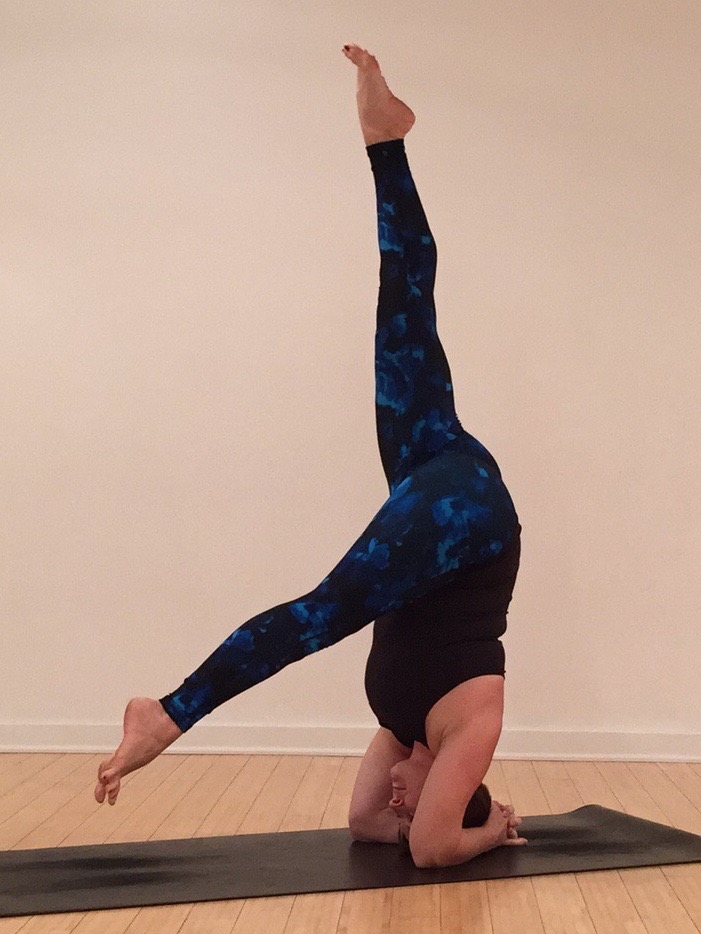 Option 2 – Split Entry. When you feel stable in strong in the prep pose, slowly lift one leg in the air. Make sure nothing in the base was compromised before going further. Gently scissor the legs together and coil slightly through the belly to hover the bottom toes off the earth. Breathe here to cultivate confidence and core control. When you are ready, lift the legs to a 90* angle. At first, it may be difficult to lift away from the floor. When we change our relationship with gravity, sometimes we need to relearn how to use our core muscle and even create a new connection with them. You may need to work with the bottom toes on the ground while you scissor and coil for a while. Resist the temptation of hopping or jumping as that can produce a wobbly and unstable entry.
 Option 3 – Sālamba Śīrṣāsana. Once the ground work is established, the legs can be slowly brought completely overhead creating a lone line of the spine. Maintaining the strong foundation is key. It’s also important to keep the legs active, with a slight hug to the midline. Many times, when yogis try to bring the legs up it’s done too quickly which causes the base to jostle or become unstable. Or, they completely forget about and abandon the integrity of the base causing everything to collapse. Moving slowy, keeping the base of the forearms pressing and shoulders pulling towards the hips can mitigate these tendencies. Slight adjustments can be made to the base to maintain balance. If you feel the feet going to far past the hips, press into the elbows. If you feel the feet dropping back towards the floor, press into the fists. These adjustments should be subtle, but will help you maintain balance and find the perfect center point. Work to balance in this pose for 1 to 5 minutes. Descend slowly and rest in child’s pose when you are done.
 Option 4 – Śīrṣāsana Variation. When you are able to consistently find a stable headstand, start to introduce leg variations. For the purposes of the pose we are building towards, slowly separate the legs bringing one forward and the other behind. Try to keep the hips squared. Reach the legs as long. To add more challenge, bend the back knee and reach the back foot a little farther, while maintaining balance. If needed, practice near a wall to help maintain balance and stability. Return to Headstand and work on the opposite side.
Move slowly and meditatively as you explore Headstand. Practice in a manner that is safe for you. This is something that needs to evaluated and determined on a daily basis. Follow this #PowerPose challenge @suzannewrightyoga on Instagram or at Suzanne Wright Yoga on Facebook. If you post your pictures or about your experience be sure to tag #PowerPose and @suzannewrightyoga.
“Put your oxygen mask on first.” That’s what we always hear from the attendants just before a flight. When you are sitting next to a young child or a loved one, you might have second thoughts. But, this is a good lesson and reminder for all of us. If someone needs our help, we need to have something to give if we are going to do any good. If we are passed out due to lack of oxygen, we are no help to anyone, especially those who are most dear to us.
The sage Viśvāmitrā is a great example of this. In yogic lore, it is said that when he was King, he was so compassionate of his subjects that he would do anything to help them. He would go so far to help that he would deplete all of his energy, to the point where he was completely spent. (I certainly can relate.) Viśvāmitrā would routinely exhaust his energy and need to replenish. At these times he would return to his practices of meditation and penance to refuel and restore.
This week’s PowerPose, Viśvāmitrāsana is dedicated to the sage. Just has he routinely gave all his energy, you may feel that way while cultivating this balancing posture. This complicated posture requires balancing in side plank, bind-ready shoulders, open hips, and elastic hamstrings. Mūla bandha or the energetic lift through the pelvic floor is also needed to create stability in the pose. The poses that have been highlighted over the last few weeks, Parivṛtta Sūrya Yantrāsana, Vasiṣṭhāsana Variation, and Supta Pādānguṣṭhāsana, will help to prepare you for Viśvāmitrāsana.
Try these variations to deepen your practice:
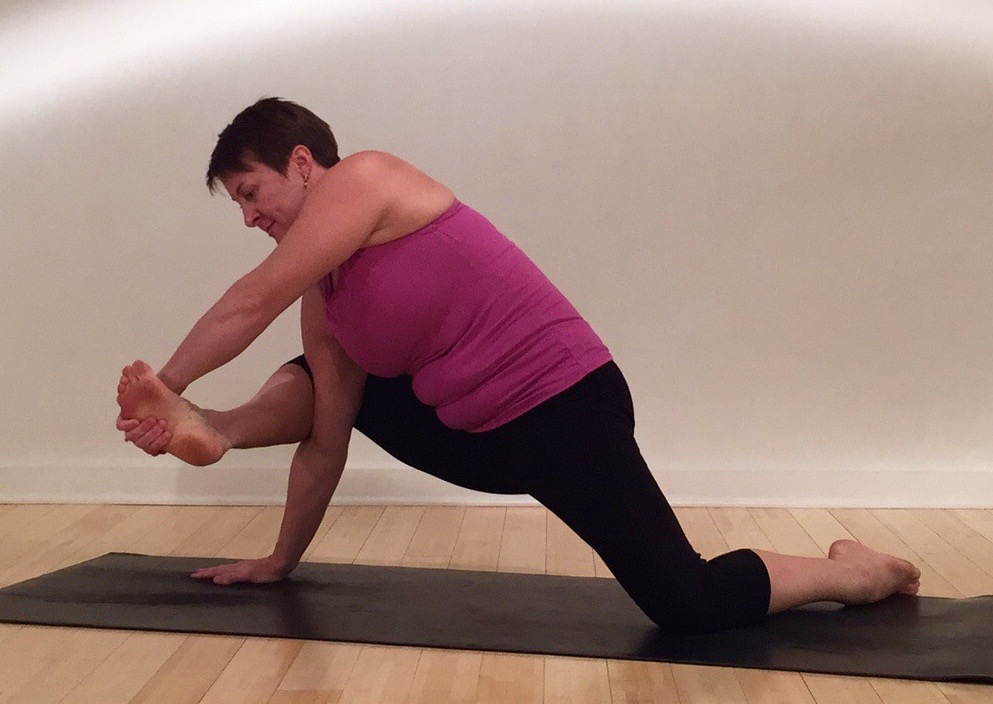 Option 1 – Kneeling Pick Up Foot: From a fingertip lunge with the right foot forward, bring the back knee down. Sink the hips forward finding as much space through the hips and hip flexors as possible. Snuggle the right shoulder behind the right knee, bringing the hand to the ground on the outside of the foot. At minimum, the knee needs to stay above the elbow joint. The further you can get the shoulder behind the knee, the more stable the pose becomes. Move the bottom foot behind you like a kickstand. Reach the left hand to the blade edge of the right foot. Engage mūla bandha, starting with a lift of the pelvic floor, and pick up the foot. Make sure the supporting or right shoulder is stable. Ensure that the knee stays above the elbow joint. Breath as you maintain balance, then try the other side.
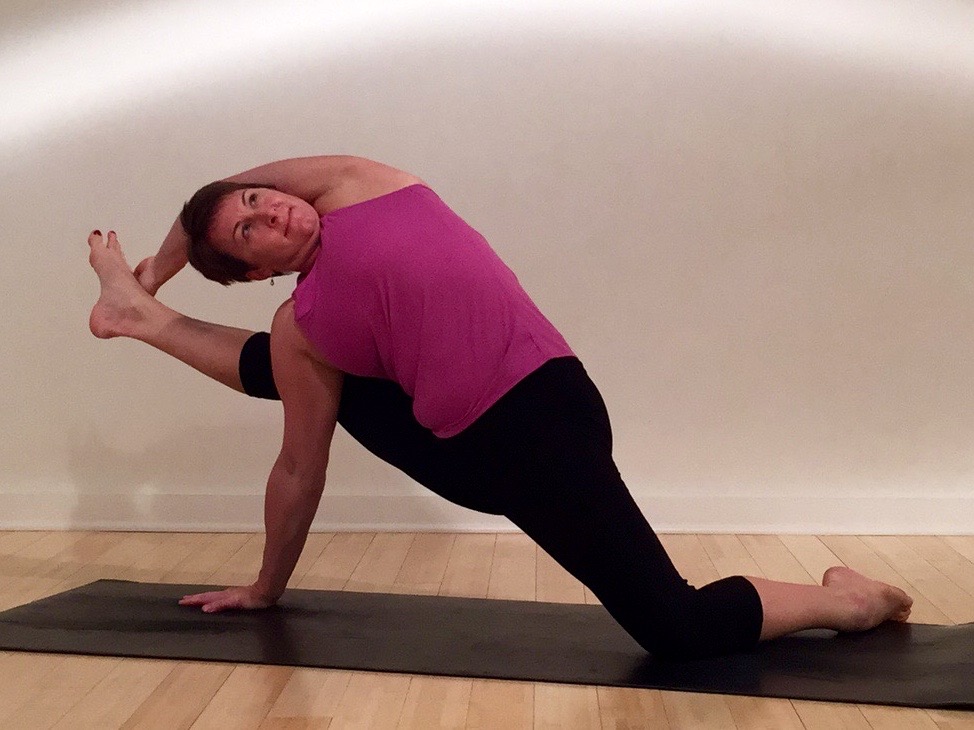 Option 2 – Extend the Top Leg: From Option 1, if your balance is stable, begin to extend the top leg as you draw the arm and shoulder behind you opening through the heart. Create space through both sides of the body as you expand. You may need to reset, bringing the hand further away from the back knee, so you have enough space. Make the foundation or base a bigger priority than extending the leg completely. You may need to work in stages building up to a leg that is at complete extension. Monitor the hip and hamstring and only go as far as the body allows.
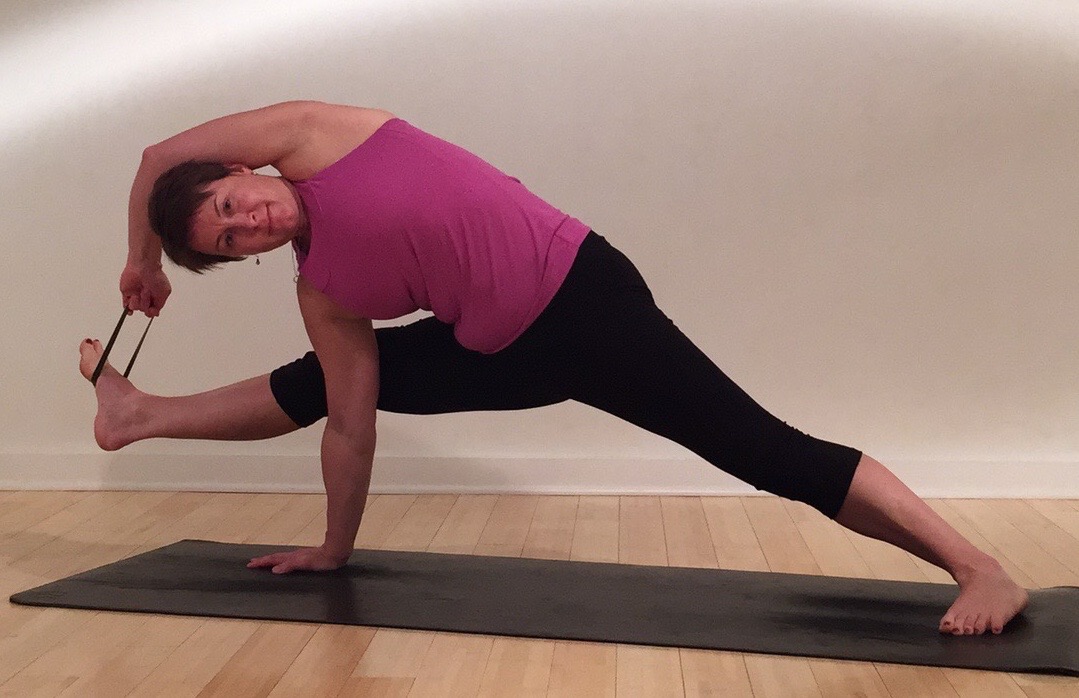 Option 3 – Plant the Back Foot: When you feel you can explore this pose while keeping the bottom shoulder stable and safe, build to plant the back foot. From a fingertip lunge, plant the back foot like a Warrior II foot. With only one foot for balance, it’s important that you use the full footprint for stability. Press through the blade edge of the foot while keeping the arch edge rooted. The toes will gently grip the mat. Image you can suction the foot to the floor through the arch. Begin to snuggle the shoulder under the knee just like you did in the kneeling variation. Work in stages to pick up the foot and begin to find extension. Work slowly and mindfully, so you do not strain the bottom shoulder or hamstring. If needed, us a short strap or binding ring to reach the foot.
 Option 4 – Viśvāmitrāsana: When you are ready, find full expansion, extending the leg completely. Press through the ball of the foot to create length through the top of the extended leg. As the shoulders allow, turn the heart skyward. It’s a simliar feeling as finding expansion in a Bound Side Angle Pose. For me, it feels like opening the windows and breathing life into a stuffy room. To take this pose one step further, release the hold of the leg and keep the shape of the pose and suspension of the leg. The top hand extends upward.
As you practice this week, consider your role as a caregiver or sharer of compassion. Do you give everything you have? How do you resupply your energy when you are depleted? Is this part of your daily practice and life?
Find the right challenge specifically for you and remember to include aspects of the practice that will refuel and replenish you. Follow this #PowerPose challenge @suzannewrightyoga on Instagram or at Suzanne Wright Yoga on Facebook. If you post your pictures or about your experience be sure to tag #PowerPose and @suzannewrightyoga.
 suzanne wright yoga